The Silk Road Journal · Selling · How to sell your racehorse series
Vet, X-rays and passport: what a buyer will ask the seller
Sooner or later, every buyer says the same thing: "Lovely. Can my vet see him?" Here is what that vet will ask, what it costs, and how to have the answers ready before anyone asks.
A light-hearted look at the horse world. Faris, Auntie Mariam and the Man Who Knew the Sire are invented. Facts are sourced at the end. Nothing here is financial, legal or veterinary advice, and no horse in this article is for sale.
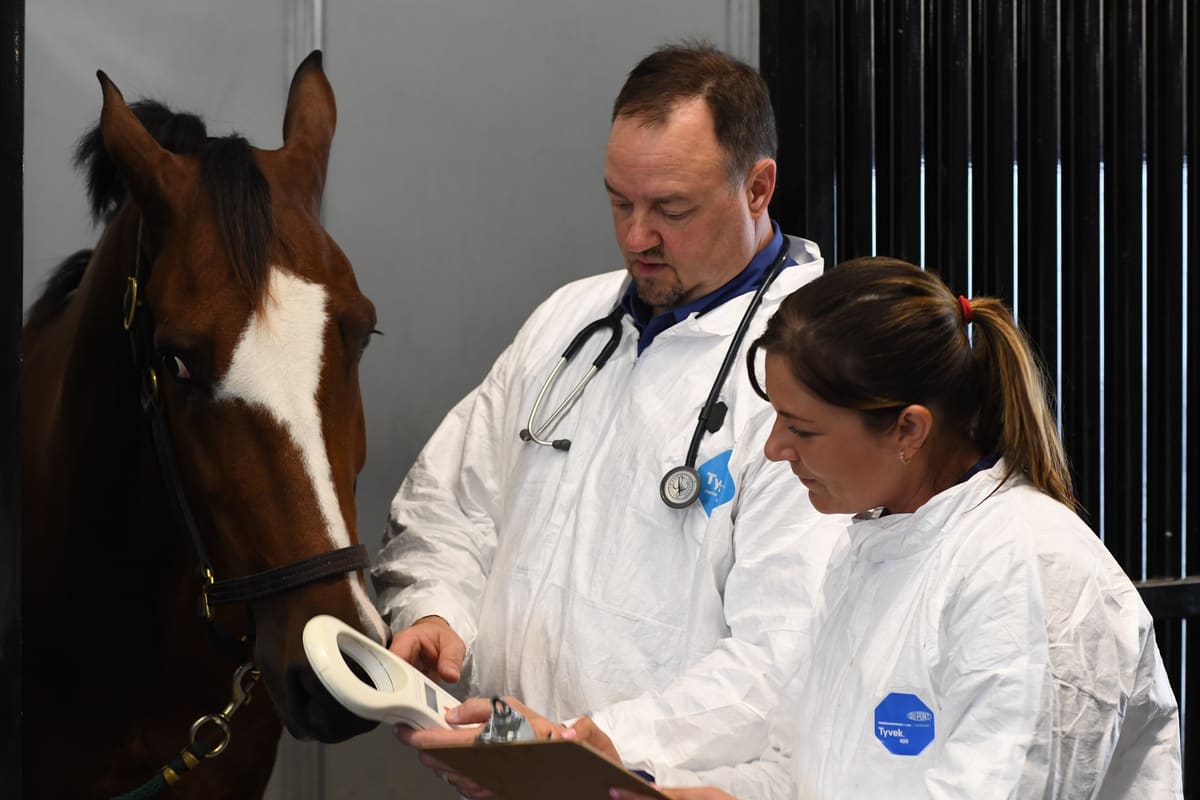

A serious buyer will ask for 4 things: the passport (identity, microchip and vaccinations), proof of who owns the horse and who can sign, the vet history (including anything a seller declaration should mention), and a pre-purchase vetting by the buyer's own vet, often with X-rays and a scope of the wind. In the UK a 2-stage vetting costs about £260-£290 and a 5-stage about £390-£410 (2026 prices, including VAT); the buyer usually pays. At the sales, sellers can lodge X-rays and scopes in a repository that only vets can view.
Faris (invented) has a buyer. The buyer has a vet. The vet has a list. Auntie Mariam has found the passport, in the drawer with the coffee machine's warranty, exactly where she said it would be.
The 8 questions every buyer asks
- Can I see the passport, and does the microchip match?
- Are the vaccinations up to date?
- Who owns the horse, and who can sign?
- Has the horse had any injury, surgery or wind operation?
- Are there recent X-rays, and can my vet see them?
- Has its wind been scoped?
- Can my vet examine it, and when?
- Is there anything else I should know?
Question 8 is the one that matters. An honest answer now costs far less than an awkward one after the vet has found it.
The passport: identity, microchip, vaccinations
The passport goes with the horse. In Britain, the seller must hand it to the buyer, and the buyer updates the ownership within 30 days through the passport-issuing body (Weatherbys for Thoroughbreds).
- Check the microchip matches the passport before anyone else does. Horses born before July 2009 without a chip need one fitted by a vet; in England you can be fined if a horse is not microchipped.
- Check the vaccination pages. Racing and import rules both depend on them, and a gap can delay a sale abroad.
- Make a clear copy of the identity and vaccination pages for buyers. Keep the original safe until you are paid.
The buyer's vetting: what happens and what it costs
A pre-purchase vetting is the buyer's vet's opinion on whether the horse suits the buyer's plans, on the day. It is not a pass or fail, and it cannot promise the future.
| Check | What it covers | UK price, 2026 (incl. VAT) |
|---|---|---|
| 2-stage vetting | Exam at rest, then walk and trot in hand; about 1 hour | About £260-£290 |
| 5-stage vetting | Adds hard exercise, rest and a second trot-up; up to 2.5 hours, needs a rider | About £390-£410, with blood storage |
| X-ray package | Joints and areas the buyer's vet chooses | About £395-£650 (Royal Veterinary College) |
The buyer usually pays, because the vet works for the buyer. Visit fees are extra, and prices differ by country. A blood sample is usually taken and stored, often for about 6 months, so it can be tested for drugs if a question comes up later.
What the seller provides: a quiet stable, someone to lead the horse, a firm level surface for the trot-up, and (for a 5-stage) a rider. What the seller should not provide: commentary. The vet hears "he's never been lame in his life" about 9 times a week.
The Silk Road Letter
Twice a month: the sales worth watching, one buying tip and one real market number (plus the odd catalogue joke). Free with it: our 2026-27 sale calendar (PDF) and a one-page guide to what a racehorse really costs. We email a link to confirm first. Unsubscribe in one click.
X-rays and the wind: what sellers can do in advance
At the sales, sellers can lodge X-rays and a scope video in a repository before the sale. Only registered vets can view the files.
- Timing: at Tattersalls, X-rays for a horse in training must be taken within 14 days of the sale's first day.
- The scope: Tattersalls asks for at least 45 seconds of clear footage of the larynx, ideally 60.
- Responsibility: Tattersalls does not view the files or give a warranty on them. The seller answers for them.
- After a horses-in-training sale, a buyer can refer a horse for its wind within the time set in the conditions. A vets' panel tests it, and the losing side pays £650 + VAT under the current notice.
For a private sale, the same files help just as much. A buyer abroad who can send recent X-rays to their own vet the same evening is a buyer who stays interested.
Should I fill in a seller declaration?
We think so. The British Horse Society points buyers to a seller declaration form, and good buyers will ask for one.
It lists known injuries, treatments, vices and operations. Declaring a healed problem with a vet's note is far better than having it found. A finding the seller did not mention costs more than the finding itself, because the buyer starts wondering what else is missing. At Tattersalls Online, vendors alone answer for their catalogue details.
Blood samples and drug tests at the sales
At Tattersalls, nobody may take blood from a horse without the seller's written permission. A buyer can ask for a drug test through the Purchase Confirmation Form, which costs £540 + VAT under the current guidance. If your horse has had any medication recently, tell your vet and the sale company first.
The seller's checklist
- Passport found, microchip checked, vaccinations up to date.
- Proof of ownership, and every owner's agreement to sell.
- Vet history in one folder, with a seller declaration.
- Recent X-rays and a scope, if the price justifies them.
- Walk and trot video, race replays, clear photos.
- A date when the buyer's vet can come, and a rider for a 5-stage.
Faris ticked all 6. The vet said "hmm" once, briefly, about an old splint that was already in the declaration. The buyer shrugged. Auntie Mariam framed the declaration.
Getting your horse ready to sell? Email us first.
Send "SELL", the horse's name and where it is trained. We tell you what buyers will ask for, prepare an honest profile with you, and introduce the horse privately to buyers worldwide. Listing is free, and nobody sees your horse without your written OK.
Email info@silkroadbloodstock.com first, from anywhere in the world. Phone +971 52 311 2385 second. WhatsApp as backup.
Our selling terms: listing is free. We charge 5% of the final price (minimum US$5,000) only if the horse sells to a buyer we introduce, including through our website, within 6 months of that introduction. If we are ever paid by both sides, both are told in writing first. Full details: fees and process.
Are you the trainer?
You stay the owner's contact. If the horse sells to a buyer we introduce, you receive 20% of our fee, paid out of our fee and never added to the price, and the owner is told in writing. Terms for trainers.
Buying instead?
We buy for clients wherever they live and race, from the best sales and private sellers all over the world. 5% (min US$5,000), agreed in writing, and you pay the seller directly.
Horse not sold at the Horses in Training sale? Our After-the-Sale Desk replies within 24 hours.
The "How to sell your racehorse" series
- How to sell a racehorse in training: auction, private or agent (the main guide)
- How much is my racehorse worth? (2026 guide)
- Selling a racehorse privately vs at auction
- Selling a horse out of training: costs, timing, paperwork
- Selling a racehorse to Gulf and Asian buyers
- What does a bloodstock agent do? (And what 5% pays for)
The Silk Road Letter
Twice a month: the sales worth watching, one buying tip and one real market number (plus the odd catalogue joke). Free with it: our 2026-27 sale calendar (PDF) and a one-page guide to what a racehorse really costs. We email a link to confirm first. Unsubscribe in one click.
Frequently asked questions
Who pays for the vetting when I sell my horse?
Usually the buyer, because the vet acts for the buyer. In the UK a 2-stage vetting costs about £260-£290 and a 5-stage about £390-£410 (2026 prices including VAT), plus visit fees.
Do I have to give the passport to the buyer?
Yes. The passport goes with the horse. In Britain the buyer then updates the ownership with the passport-issuing body within 30 days. Keep the original until you have been paid in full.
Should I get X-rays before selling my racehorse?
For a horse of real value, recent X-rays and a scope help buyers decide quickly, especially buyers abroad. At Tattersalls, X-rays for horses in training must be taken within 14 days of the sale's first day to go in the repository.
What is a seller declaration?
A written list of known injuries, treatments, vices and operations, given to the buyer. The British Horse Society points buyers to one. Declaring a healed problem is far better than having it found.
Can a buyer return a horse bought at auction because of its wind?
At a Tattersalls horses-in-training sale, a buyer can refer a horse for its wind within the time set in the conditions of sale. A vets' panel decides, and the losing side pays £650 + VAT under the current notice.
Spotted an error? Email info@silkroadbloodstock.com and we will fix it within 48 hours.
Sources
Checked 25 October 2026. Fees and rules change, so check the source before you decide.
- GOV.UK, Horse passports (give the passport when you sell; buyer updates within 30 days; microchips)
- Retraining of Racehorses, change of ownership (Weatherbys record, 30 days)
- BEVA, pre-purchase examination guide: the five stages
- RCVS, supporting guidance 7: equine pre-purchase examinations
- British Horse Society, pre-purchase veterinary examination (no pass/fail, blood stored, seller declaration)
- Royal Veterinary College Equine Practice, price list (checked October 2026)
- Stable Close Equine (Horsevet), price list (checked October 2026)
- Tattersalls, Notices to Purchasers: Repository and Repository Rules
- Tattersalls, BEVA radiograph views and endoscopy guidelines for horses submitted for sale (March 2024)
- Tattersalls, Guidance for Purchasers (pre-bid inspection, wind returns £650 + VAT, drug test £540 + VAT)
- Tattersalls Online June Sale 2026, sale information notice (entry £160 + VAT, 5% vendor commission, vet certificate within 14 days)